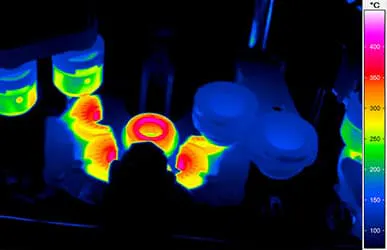
Thermography in the Photovoltaic Industry
Thermography can make an important contribution to the development and manufacture of solar cells and modules, as well as to the inspection of solar systems. This testing method is employed to
Efficiently detect performance losses in cells and modules
Identify defective cells and modules
Analyze solar cells of all types (TOPCon, Heterojunction, PERC, BC, etc.) in a contactless and non-destructive manner
Increasing the efficiency of solar cells is one of the key priorities in photovoltaic research. Recent developments have led to increasingly complex, multi-layer cell structures. Active thermography enables non-destructive testing of individual solar cell layers and the detection of faults through hot spots.






Lock-in Thermography on Solar Cells
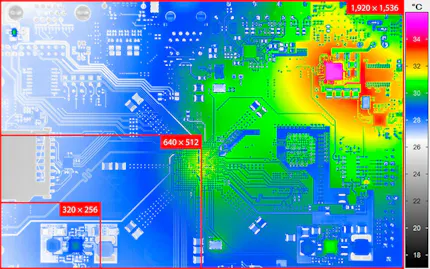
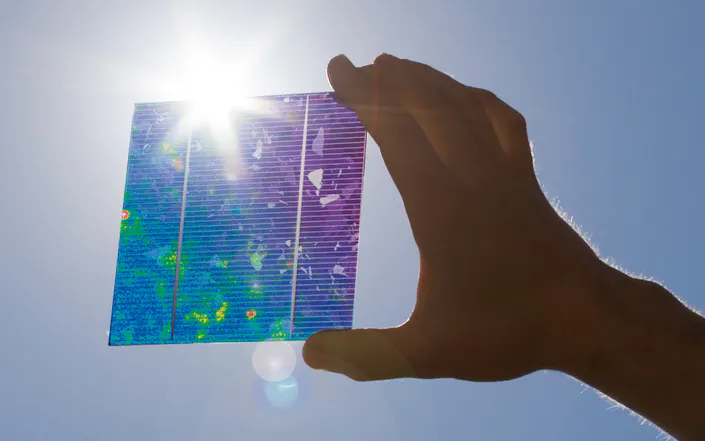
Passive thermography – a reliable and established method for functional testing and characterization of large solar modules – quickly reaches its limits when it comes to continuous production monitoring and solar cell research and development. However, Lock-in Thermography combined with high-performance infrared cameras can detect temperature differences in the microkelvin range. These local heating effects are caused by cell defects during contactless (Light Modulated Lock-in Thermography, LimoLIT) or contact-based (Voltage-modulated Lock-in Thermography, VomoLIT) periodic excitation of the test object.
The so-called leakage current plays a decisive role in efficiency and thus the overall performance of a solar cell. This loss current, which negatively affects the efficiency of the solar cell, is mainly caused by thermally excited charge carriers in the semiconductor material that diffuse across the space charge zone of the pn junction diode – opposite to the direction of the photocurrent.
Causes of high leakage currents include for example material defects, impurities, and surface or edge defects. Passivation defects, which play a particularly important role in PERC solar cells (Passivated Emitter and Rear Cell), are also associated with increased leakage currents.


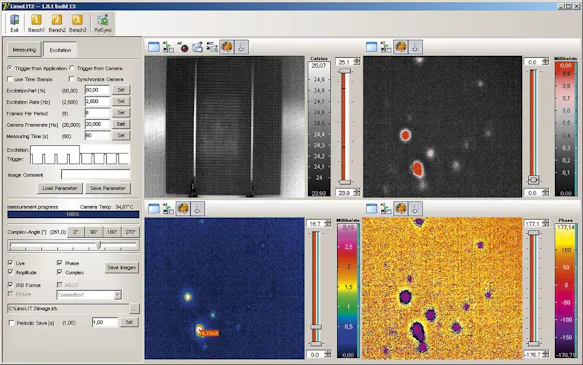
Thermographic analyses of solar cells have shown that leakage currents are practically never homogeneous across the entire surface of the cell. There are areas with low leakage currents and areas where they are locally increased, often by a factor of 10 to 1,000. These areas with high leakage currents are referred to as shunts. Lock-in Thermography allows the detection and quantitative evaluation of such shunts in solar cells.
The deployed thermography software is key to detecting these defects. It allows important test parameters such as excitation and recording frequency or excitation amplitude to be set and also enables evaluation using various active thermal imaging algorithms, comparison of measurement data, and storage of results. The information obtained helps to locate the corresponding defects and narrow down the causes of performance losses.
Benefits of Lock-in Thermography for Quality Analysis of Solar Cells and Modules


Reliable defect detection (shunts), for example, detection of leakage currents in solar cells and modules using Lock-in Thermography
Analysis of test objects with structures down to a few micrometers (µm) in size and a thermal resolution in the microkelvin range
Detection and precise localization of even weak local shunts by reducing the influence of lateral heat spread (silicon is a good heat conductor)
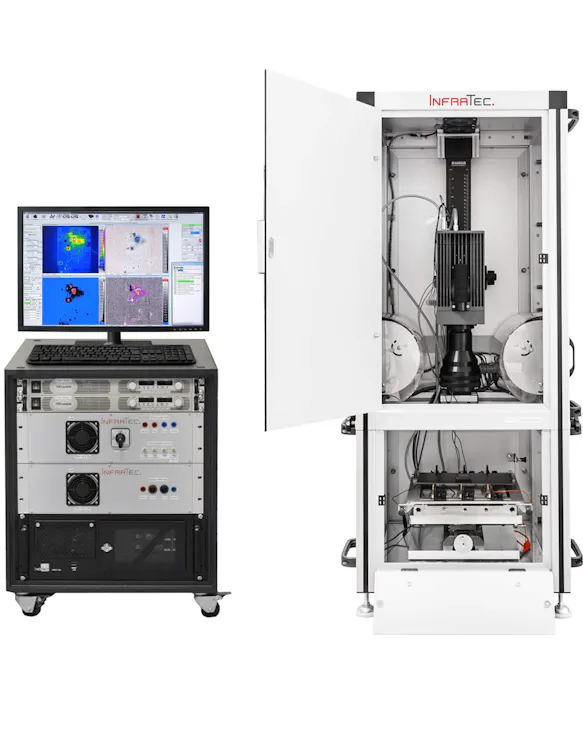
For detailed analysis of solar cells, InfraTec offers the automated thermographic system PV-LIT, which can be used for all types and formats of solar cells and modules. Excitation is carried out electrically or contactlessly with light.





Thermography for Inspecting Photovoltaic Systems
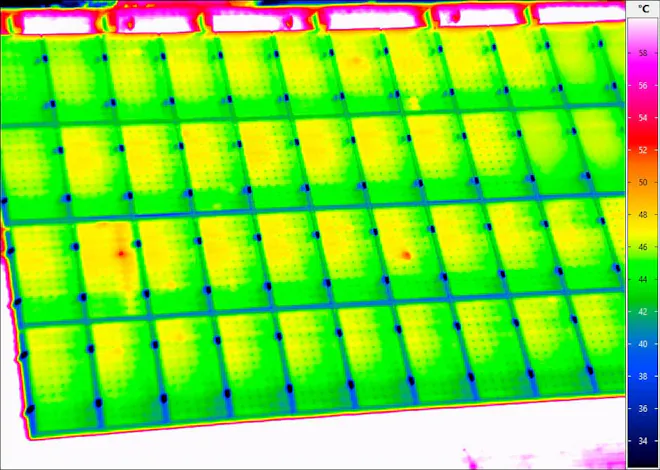
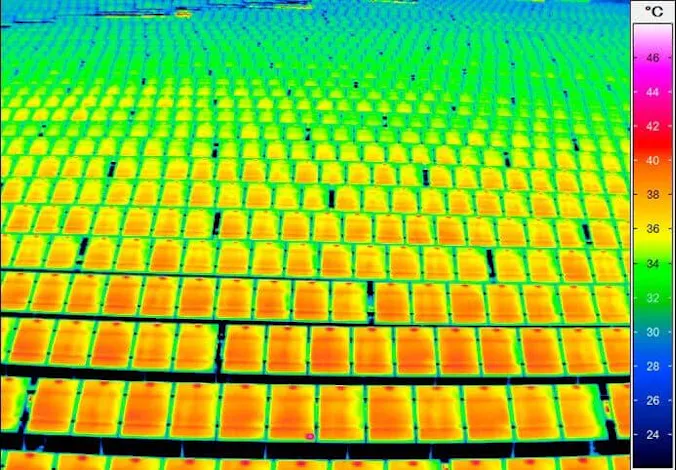
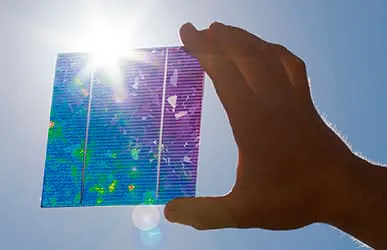
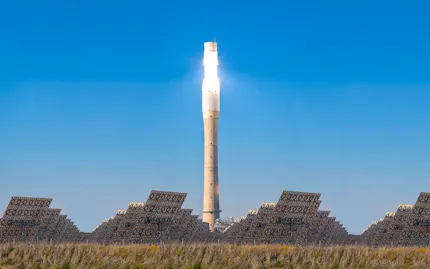
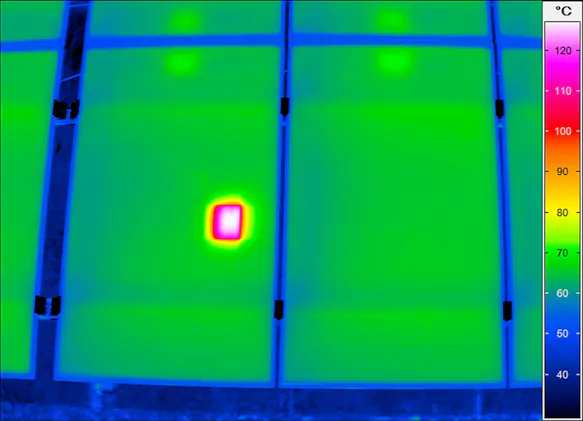
In addition to analyzing individual solar cells, thermal imaging can also be used to inspect entire PV systems. In addition to conducting analyses of individual solar cells, thermography can also be used to inspect entire PV systems. To examine these systems comprehensively for hot spots, mobile devices are usually required. In the building sector, simple infrared cameras with correspondingly low thermal resolution are typically used for small and medium-sized photovoltaic systems. In solar parks, however, it is also useful to install high-quality infrared cameras on drones or helicopters and inspect the module surfaces during aerial surveys.
Regular monitoring is definitely advisable: As with all technical equipment, photovoltaic systems are subject to aging, which usually manifests itself in the form of hot spots. These significantly warmer areas in the module or in individual solar cells are often caused by mechanical damage (for example, cracks in the conductor tracks) or delamination processes, in which the solid bond between the solar cells and the encapsulation breaks down. The defective areas act as ohmic resistances. When the current produced by the neighboring cells flows through them, the electrical energy is converted into heat. Thermal imaging can be used to measure the resulting temperature increases.




Would You Like to Know More?
It is not unusual for tasks to be associated with special requirements. Discuss your specific application needs with our specialists, receive further technical information or learn more about our additional services.