PyrIQ® – Digital Detectors for Easy System Integration
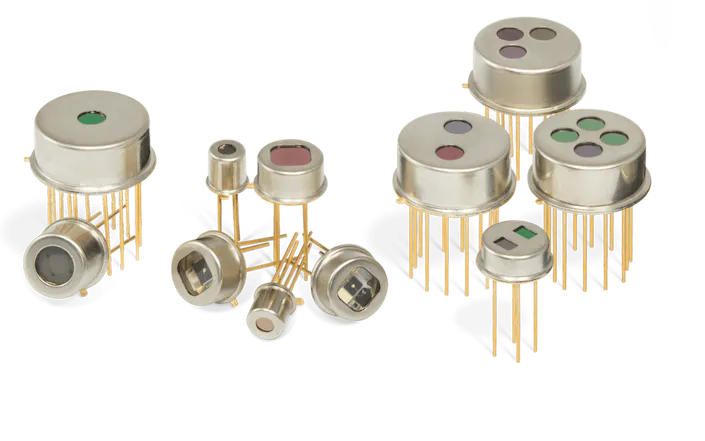
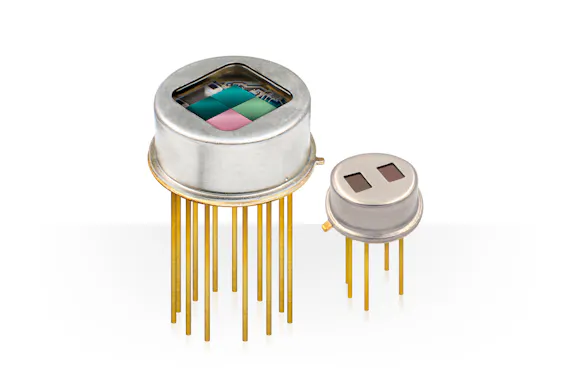
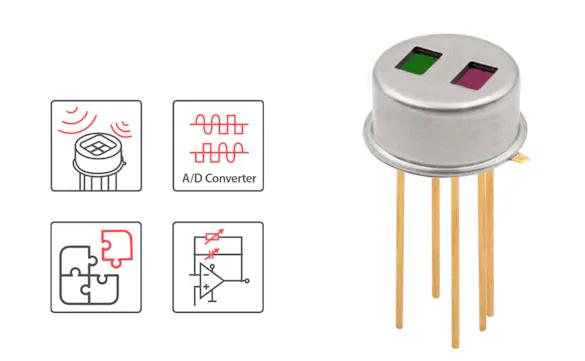
We are introducing: our digital detector for easy system integration with variable signal processing and improved electromagnetic compatibility (EMC). Like all detectors from InfraTec, it is based on single-crystal lithium tantalate (LiTaO


Type | close Number of measuring channelsNumber of Channels | close TO18, TO46: 5.4 mm in diameter Housing | close Size of the circular or rectangular aperture through which radiation hits the sensitive elements.Aperture (mm) | close Voltage Mode: The pyroelectric current is initially converted into a voltage by an RC network followed by a conversion to lower impedance. Current Mode: The pyroelectric current is permanently compensated by an OpAmp. The current required for this generates a voltage drop across an RC network in the feedback path which serves as the measurement signal. Operating Mode | close Integrated signal condition like integrated junction field effect transistors (JFET) for detectors in voltage mode or integrated operational amplifiers (OpAmp) for detectors in current mode. Amplifier | close A pyroelectric detector is sensitive to changes in temperature. Changes in ambient temperature have an influence on the measurement signal and shifts the operating point. This effect reduces a thermal compensation. Therefore, each pyroelectric element gets an additional optically inactive element, which compensates for unwanted currents. Thermal Compensation | close Patented micromechanical chip attachment (LowMicro) by InfraTec to reduce the effects of interfering impact sounds. Low Micro | close As a key parameter, the specific detectivity D* characterizes the signal-to-noise ratio of infrared detectors. Specific Detectivity* | |
|---|---|---|---|---|---|---|---|---|---|
| 4 | TO8 | 8.5 x 8.5 | Current Mode | PyrIQ | 2.4 *** | ||||
| 2 | TO39 | ø 6.0 | Current Mode | PyrIQ | 1.5 *** |
* in 10
** in 10
*** bei R
**** in 10


Application Areas
The digital detector is ideal for simple system integration in gas analysis and flame detection. By using the digital detector, the user receives a digital measurement signal that can be read out and immediately processed.
For high-precision measurement, especially in gas analysis, synchronisation of the emitter and detector clock is necessary. For the digital pyroelectric detectors, a clock input (pin) is available for this purpose, which is used to specify the system clock or the exact sample time. This allows a time signal with a highly precise sampling rate to be generated. Another special feature compared to analogue technology of our digital detector is the “Fast Recovery after Saturation”. This function detects overdriving due to a faulty operating condition – for example, due to extreme temperature fluctuations or mechanical influences – and automatically resets the analogue front-end.
The digital detector converts the analogue signal, which can be filtered and amplified in several stages, directly into a digital signal with a 16-bit resolution. The entire signal processing is carried out by an ASIC (Application- Specific Integrated Circuit), whereby the analogue front-end acts like a classic transimpedance amplifier. Thus, users receive a digital measurement signal that can be read out via an I²C interface and immediately processed.

White Paper Digital Detector – Startup a Detector with Digital Interface
This white paper is intended to show how to put the digital detector into operation with a basic microcontroller board like the Arduino Uno. You will also learn how to configure the detector and retrieve data.


PyrIQ® Evaluation Kit – Detector Configuration in Just a Few Steps
The PyrIQ® Evaluation Kit from InfraTec supports customers in the initial testing of the digital PyrIQ® detectors without the otherwise required development of software, firmware and test circuits. The associated software allows the detector and IR source parameters to be set via an intuitive graphical user interface. Our Evaluation Kit offers an easy way to utilize the wide range of setting options for PyrIQ® detectors, speeding up the configuration and development process. In addition, the kit is also suitable for comprehending the mode of operation of an analog pyroelectric detector and the influences of its electronic components.


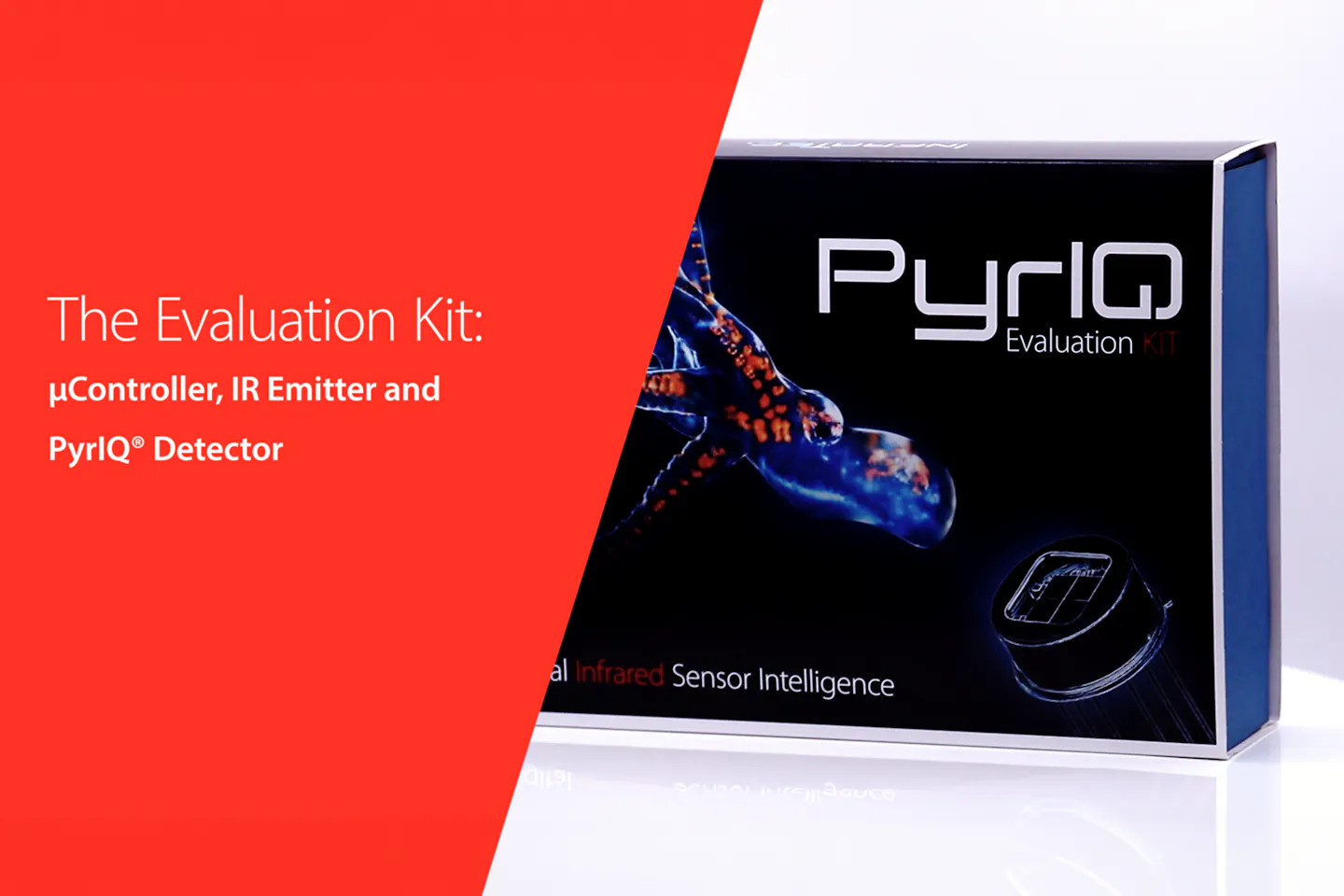
Evaluation KIT for digital detectors: A quick test setup to validate or develop your own test setup and determine the right parameters for your measurement task.







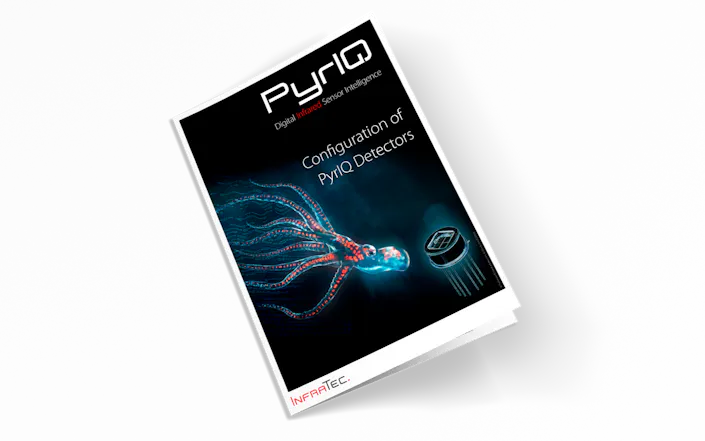
White Paper Digital Detector – Configuration of Your PyrIQ® Detector
This white paper is intended to help you find a suitable PyrIQ®-configuration for your application by following a “good practice”-strategy as well as stating the effects and potential drawbacks for all available PyrIQ®-parameters.

Analogue vs. Digital – Which Detector for which Application?
Analogue pyroelectric detectors have proven their worth for decades. Their integration into the device design can be made flexible but requires a high degree of electronic skill. The performance of the detectors can be fully utilised. Considering the effort required for system integration, digital pyroelectric detectors have clear advantages. The functions already integrated into the detector – although limiting the scope for design – significantly reduce the effort required for system integration. The following table provides a quick overview of advantages and disadvantages:
| Digital pyroelectric detectors | Analogue pyroelectric detectors | |
| Detector series | LRD, LID | LIE, LME, LIM, LMM, LRM |
| Properties | Detectors with integrated ASIC for transimpedance amplification, 16-bit A/D conversion and signal conditioning | Maximum flexibility for system integration by the user (free choice of external A/D converter and interface) |
| Electromagnetic compatibility (EMC) | ++ | + |
| Integrated temperature measurement | Yes | Yes (available for LRM) |
| Flexible adjustment of feedback components | Yes (Rf = 2 GΩ … 1 TΩ; Cf = 50 fF … 6.4 pF) | No |
| Requirements for system integration on the device side | Low | High |
| Power consumption (typical) | 1 mW | 0.1 mW |
| Signal to noise ratio | + | Current mode ++ / Voltage mode +++ |
| Sampling rate (maximum) | 1 kHz | Free to select |
| Max. Modulation Frequency | 100 Hz | 4 kHz |
| Supply voltage | 1.8 … 3.6 V | Up to ± 5V |


Would You Like to Know More?
It is not unusual for tasks to be associated with special requirements. Discuss your specific application needs with our experienced engineers, receive further technical information or learn more about our additional services.


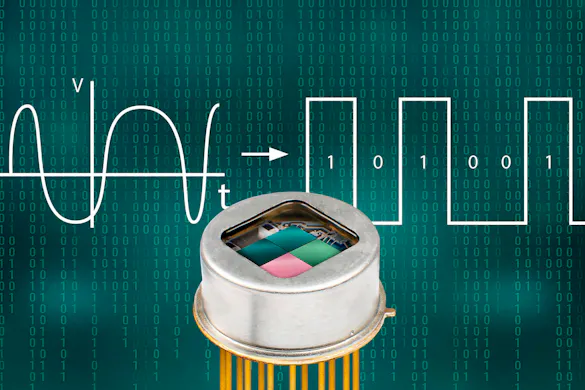


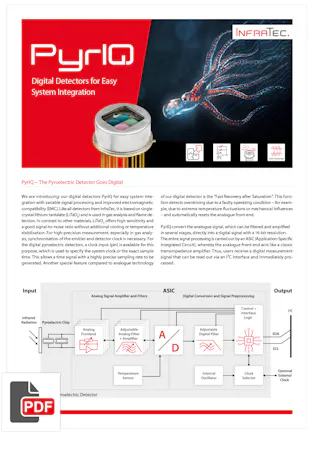
Download Flyer
Download the flyer about the digital detectors and learn more about the possibilities using a digital detector.


Various Fields of Application for PyrIQ® Detectors
Digital detectors are just as suitable for the use in gas analysis and flame sensing as detectors with analogue signal output. But especially if the environmental conditions require a compact and easy-to-integrate detector, a detector with integrated digitisation will be a good choice. Thus, among other things, the digital version is suitable for the field of air-conditioning and building technology when it comes to measuring air quality. Since this correlates well with the carbon dioxide concentration in the air, the CO


The CO
Further Possible Applications for the Digital Detector:
Agricultural industry, for example for monitoring the atmosphere in greenhouses and in research projects on plants
Gas detectors for explosive gases, for example for mining or drilling platforms
Process gas analysis, for example for measuring exhaust gases in industrial plants
Frequently Asked Questions About PyrIQ® Digital Detectors
PyrIQ® detectors are digital pyroelectric infrared sensors in which the sensing element, signal processing, and analog-to-digital conversion are integrated into a single detector. The measurement signal is provided digitally via an I²C interface and can be further processed directly by a microcontroller.
Simple system integration
Thanks to the integrated signal processing and A/D conversion, the detector can be connected directly to a microcontroller. This allows the analog front end and subsequent signal processing to be adapted for each individual channel, thereby optimizing sensitivity and the signal-to-noise ratio.
Flexible configuration
The detector parameters can be adjusted both during development and during operation.
Improved electromagnetic compatibility (EMC)
The digital output signal is less susceptible to external interference.
Directly usable digital signal
The internally amplified and filtered signal is output digitally with a resolution of 16 bits and can be processed directly.
Fast recovery after saturation
Detector saturation is detected, and the input stage is automatically reset.
Analog pyroelectric detectors have proven their reliability over many years and offer maximum flexibility in circuit design. However, their integration requires a high level of electronic expertise.
Digital PyrIQ® detectors significantly reduce integration effort, as central functions are already included in the detector. This simplifies and accelerates development.
The main technical difference lies in signal processing:
Analog detectors typically have an integrated impedance conversion (e.g., using a JFET or operational amplifier) and provide an analog output signal.
PyrIQ® detectors use an integrated ASIC (Application-Specific Integrated Circuit) that handles amplification, filtering, and digitization.
Analog detectors and their highly specialized components, alongside optimized signal processing, can achieve slightly higher detectivity (D*) than digital PyrIQ® detectors.
Typical areas of application:
Flame sensors
Gas analysis
PyrIQ® detectors are the ideal solution for applications where compact design, low development costs and easy digital integration are key. Due to the per-channel individually programmable settings, PyrIQ® detectors are also excellently suited for applications with highly variable operating conditions.
The optimal configuration depends largely on the specific application. The white paper entitled "Configuration of PyrIQ® Detectors" serves as a guide and provides detailed information on parameterization.
For example, the feedback resistor in the analog front end has a significant influence on detector performance. This resistance is freely configurable for the detectors of the PyrIQ® series, and the user can significantly influence how sensitively and how quickly the detector responds:
High feedback resistance / e.g. 128 GΩ
SNR (Signal to Noise Ratio) +++
Response time +
Temperature stability +
Low feedback resistance / e.g. 4 GΩ
SNR (Signal to Noise Ratio) +
Response time +++
Temperature stability +++
Changing the feedback resistor is an effective measure – unlike simple post-amplification – to find the best compromise between sensitivity (detectivity) and response speed. Simple post-amplification amplifies both the detector noise and the signal equally, but does not change the detectivity.
Yes. An Evaluation Kit is available for initial tests. This evaluation kit supports customers in the initial testing of digital PyrIQ® detectors, without the need to develop software, firmware, and test circuits that would otherwise be required. The accompanying software allows adjustment of detector and IR source parameters via an intuitive graphical user interface. Our Evaluation Kit makes it easy to take advantage of PyrIQ® detectors' wide range of setting options, speeding up the configuration and development process.
The relevant documents can be requested directly from InfraTec via an inquiry form.
No I² C Communication Possible
The cause may be an excessively high bus capacity, for example, due to long lines. Another possible cause is that the power-down pin is not connected to ground.
Solution:
Reduce cable lengths or adjust bus speed.
Connect power-down pin to ground (GND).
Wrong Channel Responds
ASIC channels do not necessarily correspond to the optical channels.
Solution:
Check the assignment in the data sheet.
OVW Bit Set in the Status Register
If data is not read out fast enough, the ASIC overwrites it and sets the overwritten bit (OVW bit).
Solution:
Use interrupt-based readout or count clock signals and read out synchronously.
PyrIQ®detectors use an I²C interface that supports bandwidths up to 1MHz (FM+). This interface is widely used, requires only two lines (SDA and SCL) and allows for easy integration of multiple sensors on a common bus.
PyrIQ® detectors are operated at a supply voltage of between 1.75 and 3.6 V. The power consumption in normal operation is between 70 and 200 µA, depending on how many channels of the ASIC are used.
Please note:
The supply voltage must be stable and low-noise, as supply noise can affect the measurement quality.
When switching on the detector, a short settling time must be allowed before valid measurement values can be read out.
Yes, PyrIQ® detectors are both REACH- and RoHS-compliant.
Detector Search
InfraTec offers different product groups including approximately 50 standard pyroelectric detectors. Detectors with reduced microphone technology and integrated operational amplifier as well as digital detectors and high-performance detectors for spectrometers are part of our product range.
Choose your suitable infrared detectors with the help of our detailed detector search.