Thermal Images of Freezing Drizzle Droplets
To better understand ice formation processes in the atmosphere, scientists at the Karlsruhe Institute of Technology (KIT) conducted experiments with freezing water droplets. They used a high-resolution ImageIR® 7340 infrared camera and a high-speed camera to precisely document temperature and shape changes during freezing. The aim was to analyze mechanisms by which freezing, drizzle-sized cloud droplets break apart and release ice fragments (known as secondary ice formation), which can trigger the freezing of further droplets.


The experiments were conducted in an electrodynamic trap, where droplets were examined in suspension under controlled conditions of temperature, humidity and air flow. Ice formation was stimulated by the targeted introduction of fine ice particles.
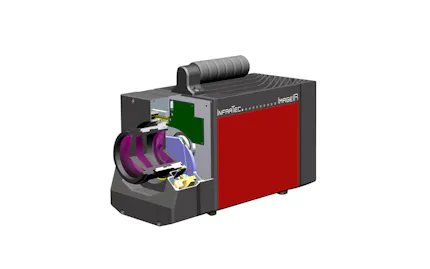
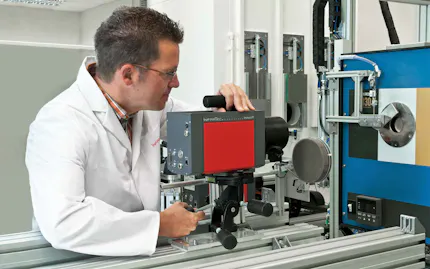
An ImageIR® 7340 MWIR infrared camera with a 50 mm lens, close-up adapter, and extension rings for 2x magnification were used to measure the droplet surface temperature during freezing. The camera offers an accuracy of ±1 K in the temperature range of (-30 … +30) °C and a frame rate of 287 frames/s. The thickness of the emitting layer was 36 µm for water and 24 µm for ice, so that only the outermost layer of the droplet was captured in each case.
InfraTec Solution
Karlsruher Institut für Technik (KIT)
Institute of Meteorology and Climate Research
Atmospheric Aerosol Research (IMK-AAF)
www.imk-aaf.kit.edu
Infrared camera:
ImageIR® 7340


As water and ice are not ideal black bodies in the relevant spectral range and the droplet geometry can affect the measurements, the measurements focused on the central region of the droplet.
The measurements showed three clearly distinguishable phases (see Fig. 2):
Initial phase: Immediately after the freezing process was initiated by external ice particles, the droplet heats up to the melting temperature of ice (approx. 0 °C) due to the latent heat released during crystallization.
Crystallization phase: As crystallization progresses, the temperature stabilized at this constant level until all the liquid water has solidified.
Cooling phase: After crystallization was complete, the droplet cooled exponentially to the ambient temperature.


Modeling the Cooling Process
A simple heat and mass transfer model was developed to describe the processes, accounting for both complete crystallization (phase 2) and subsequent cooling to ambient temperature (phase 3).
This model takes into account the release of latent crystallization heat, heat conduction inside the droplet, heat transfer to the environment through heat conduction (heat diffusion), free and forced convection, and ice sublimation at the droplet surface.
The cooling of the completely frozen droplet to ambient temperature (phase 3, cooling model) was calculated based on a solid ice sphere at the melting point and under ambient pressure. Overall, the modeled surface temperature corresponds very well to the measured values.


Investigation of Pressure Release Events (PREs)
High-speed recordings documented events such as fragmentation and bubble formation, which were always accompanied by a slow decrease in temperature and a sudden increase in temperature. This indicates a pressure-induced freezing point depression, followed by a rapid drop in pressure due to cracking in the ice shell (see inset in Fig. 4).
Thermography proved to be significantly more sensitive than high-speed video technology, detecting three to nine times more PREs (see Fig. 5).


In free fall, PREs occurred about three times more frequently than in still air, which can be attributed to the freezing process being accelerated by airflow and increased internal pressure. Higher temperatures led to more stable ice shells, while rapid freezing produced more brittle structures.
The study shows that thermography can not only provide precise temperature profiles of freezing droplets but also offer a significantly higher detection rate for pressure-related events (PREs). As these processes contribute to the formation of secondary ice crystals, they are crucial for understanding ice and precipitation formation in mixed-phase clouds.
Scientific source
Kleinheins, J., Kiselev, A., Keinert, A., Kind, M., and Leisner, T. (2021): Thermal Imaging of Freezing Drizzle Droplets: Pressure Release Events as a Source of Secondary Ice Particles, Journal of the Atmospheric Sciences, 78, 1703-1713