Safe Handling of Refrigerants
Modern technical refrigerants have been in use for nearly 100 years, and the market has seen significant growth in recent years. Rising prices for fossil fuels and increasing average temperatures are driving demand for more efficient heat pumps and air conditioning systems. All of these systems rely on refrigerants to function.
To ensure the safety of refrigerant systems, particularly in enclosed spaces, leaks must be detected and, if necessary, the concentration of individual components must be determined. NDIR gas analysis using pyroelectric detectors from InfraTec delivers reliable results for a wide range of refrigerants. This applies not only to established refrigerants – some of which have a high climate impact – but also to new, more sustainable alternatives replacing them.


Application of Refrigerants
Refrigerants are used in many areas of everyday life, such as
cooling (refrigerators, freezers, cold storage and deep-freeze facilities, food processing, refrigerated containers etc.),
air conditioning (air conditioning systems in rooms, buildings and vehicles),
heating (heat pumps in households, hot water production, industrial heat pumps for waste heat recovery),
process cooling in industrial and technical processes (for example, in the chemical, pharmaceutical or plastics industries),
for cooling machines and equipment (for example, in semiconductor industry processes or the cooling of server farms),
in numerous specialized applications, such as cryogenics, medical technology (including laboratory cooling, blood banks, and MRI systems) and environmental technology (e.g., heat recovery).


Most refrigerants are gaseous at room temperature and standard pressure and are therefore often referred to as refrigerant gases or cooling gases. These cooling gases are characterized by their ease of liquefaction and vaporization, enabling highly efficient heat transfer during the phase transition.
The following table lists typical refrigerant gases and their applications:
| Category | Refrigerant | Note / Typical Application |
| Inorganic refrigerants | Ammonia, NH3, R717 | Industrial refrigeration systems, ice sports facilities, large-scale heat pumps |
| Carbon dioxide, CO₂, R744 | Chest freezers in retail, transport, and industrial refrigeration | |
| Water, R718 | Absorption refrigeration systems, high-temperature heat pumps, etc. | |
| Air, R729 | Aircraft air conditioning, cryogenics | |
| Organic refrigerants (hydrocarbons) | Propane, R290 | Commercial refrigeration, heat pumps, air conditioning systems |
| Isobutane, R600a | Domestic refrigerators | |
| Propene, R1270 | Industrial refrigeration systems, deep-freeze applications | |
| Synthetic refrigerants (F-gases) |
HFCs (hydrofluorocarbons) | |
| R134a | Older vehicle air conditioning systems | |
| R404A (blend) | Formerly used in commercial refrigeration systems | |
| R410A (blend) | Air-conditioning systems | |
| R407C (blend) | Heat pump systems | |
| HFOs (hydrofluoroolefins) | ||
| R1234yf | Modern car air-conditioning systems | |
| R1234ze | Cooling and heat pump systems | |
| R513A (blend) | Replacement for R134a | |
Detection of Refrigerant Gases
Refrigerants circulate in closed loops within refrigeration, air conditioning, and heat pump systems and are not consumed during operation. They are released into the environment only in the event of leaks in the cooling system. This is particularly problematic when the refrigerant gases are toxic, flammable, explosive or have a high global warming potential. Pyroelectric infrared detectors are ideal for detecting leaks in cooling systems at an early stage — especially in enclosed spaces. With certain limitations, they can also be used to determine the concentrations of leaked refrigerant gases.
Various methods are suitable for the detection and concentration determination of refrigerant gases, including FTIR spectroscopy, measurements using electrochemical detectors and photoionization detectors (PID). However, non-dispersive infrared (NDIR) gas analysis has become the standard method in many fields because it combines cost-effectiveness with durability and can be used for a wide range of gases.


NDIR-Gas Analysis of Refrigerants
Many refrigerants exhibit characteristic IR absorption bands, which enable detection via NDIR gas analysis. Since the refrigerants used are known, the infrared source, detector, and passband of the bandpass filter can be tuned to the refrigerant-specific absorption bands.
Typical IR Absorption Ranges of Refrigerants
NDIR gas analysis is particularly well-suited for stationary leak detection of a wide range of refrigerants, such as CO2, HFCs, HFOs, and a large number of hydrocarbons and chlorofluorocarbons. These refrigerants typically contain chemical bonds such as:
C–F (carbon-fluorine bond)
C–H (carbon-hydrogen bond)
C=O (carbon-oxygen double bond)
These bonds primarily vibrate in the mid- and long-wavelength infrared range between 2.5 µm and 15 µm. Many cooling gases therefore exhibit specific absorption bands that enable selective and reliable detection.
| Refrigerant | Absorption bands | NDIR suitable |
| Fluorinated refrigerants (e.g. HFCs, HFOs) |
8 – 9 µm | Well suited |
| Hydrocarbons (e.g. propane, isobutane) |
3 – 3.5 µm | Moderately suitable |
| CO₂ | 4.26 µm | Highly suitable |
| NH3 | 9 –11 µm (10.3 µm) sideband: 2.9 – 3.1 µm |
Moderately suitable (cross-sensitivity to H₂O + CO₂) |
The range between 8 and 9 µm is particularly attractive for refrigerant sensors, as many refrigerant gases exhibit distinct absorption bands in this range, yet there are no interfering effects from water bands or carbon dioxide.
The IR filter of a pyroelectric detector must be selected to provide high transparency in the range of the refrigerant's maximum absorption and minimal cross-sensitivity to interfering wavelengths. In addition, the IR source and detector must respectively provide and detect sufficient radiation in this range.
Analysis of Refrigerant Blends
When refrigerants are present as gas blends, NDIR analysis becomes more difficult, especially if the absorption bands of the individual components differ only slightly. This is particularly the case when the refrigerant gases are chemically and therefore spectrally very similar. As a rule, when cross-sensitivities are high, only the total concentration of the mixtures can be determined. If the individual gases have separate absorption bands, multi-channel detectors with specific filters for each channel allow simultaneous detection of the components and thus the measurement or calculation of individual concentrations.


Characteristics of Modern Refrigerants
In response to environmental regulations, modern refrigerants in safety class A2L (as defined by ISO 817 or ASHRAE 34) are increasingly replacing class A1 refrigerants (for example, R134a). Due to their reduced flammability, the focus with these refrigerants—mostly HFOs and HFO/HFC blends—is shifting from detecting minute leaks to measuring concentrations. For example, this is intended to reliably prevent dangerous accumulations of the refrigerant in enclosed spaces or to monitor refrigerant consumption. Detectors therefore need to be particularly stable over the long term and capable of reliably measuring concentrations ranging from high ppm levels up to the percentage range.
InfraTec Solutions
We are pleased to support you in refrigerant detection. Our catalog offers standard IR filters for refrigerants such as CO
Which refrigerants need to be detected?
Is qualitative detection (for example, to identify leaks) or quantitative concentration measurement intended?
Is the concentration of individual refrigerant gases in a blend or the overall concentration to be determined?
What effect do other gases that are or may be present in the sample have?


Multi Channel Detectors
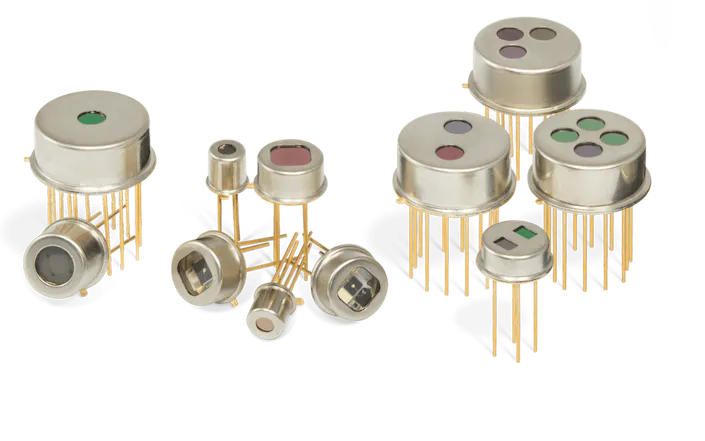
Irrespective of the answers to these questions, we recommend using planar multi channel detectors from the LIM, LMM, and LRM series, as well as digital detectors from the PyrIQ series, for the detection of cooling gases. In particular, for long-term stable leak detection, it is necessary for the detector to have a reference channel. This allows for the compensation of factors such as lens contamination, detector drift and fluctuating IR excitation.
Filters
For your specific measurement tasks, we can also provide you with a wide selection of filters. Please note: For successful detection, it is not crucial to choose the narrowest possible filter. Rather, it is important that the filter optimally covers the spectral range of interest and is robust – both of which are prerequisites for the detector to continue delivering usable results even as the IR source ages or the temperature drifts.


Detector Search
InfraTec offers different product groups including approximately 50 standard pyroelectric detectors. Detectors with reduced microphone technology and integrated operational amplifier as well as digital detectors and high-performance detectors for spectrometers are part of our product range.
Choose your suitable infrared detectors with the help of our detailed detector search.