
Quick Lens Change with Maximum Precision
Motorized Lens Turret Simplifies and Speeds Up Flexible Measurements
InfraTec's compact lens turret expands the capabilities of the E-LIT automated electronics test system and facilitates the precise detection of even the smallest defects on printed circuit boards and within circuits.
A “region of interest” identified once by the user remains in place even if the field of view changes after a lens change, eliminating the need for time-consuming repositioning. At the same time, vibrations and unintended heat input are minimized.


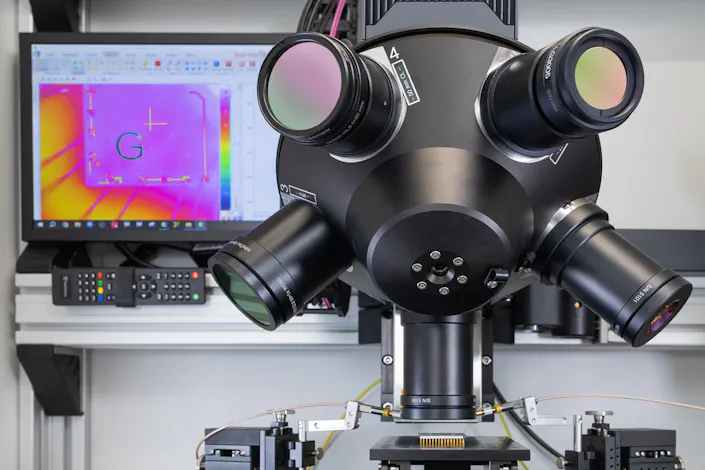
The E-LIT automated test system enables users to accurately detect and visualize even the smallest defects – such as point and line short circuits, oxidation, transistor, and diode defects – on the surface of a printed circuit board as well as within circuits. To capture thermal anomalies in ever-smaller components in detail, microscope lenses with varying magnifications are used.
Manual Lens Changes Become Obsolete
Until now, in order to test areas of varying sizes, the measurement had to be interrupted and the lens on the infrared camera had to be replaced manually. With InfraTec’s compact, motorized lens turret, this time-consuming step – which compromises measurement accuracy – will no longer be necessary. The lens is now changed by rotating the turret, which is equipped with up to five microscope lenses – the desired lens is precisely positioned and ready for use in less than 10 seconds.
Depending on the structure being analyzed – details can be resolved down to a size of a few µm – microscope lenses with, for example, 1×, 5×, or 10× magnification can be used. The desired lens is selected using the IRBIS® camera software supplied with the thermographic system, as are camera focusing and sample positioning. This allows for quick and convenient measurements ranging from overview images up to details at maximum magnification.


Stable Measurement Conditions Guaranteed
In addition to rapid operational readiness, the lens turret offers further key advantages: Thanks to its high precision, the center of the image aligns exactly with all selected lenses. A “region of interest” identified once by the user is retained even when the field of view changes after a lens change, eliminating the need for time-consuming repositioning. Furthermore, the lens turret’s smooth, even drive and its housing ensure that measurement accuracy is not compromised by vibrations of the test object or by unintended heat input. In addition, an additional sensor – for example, a high-resolution VIS camera – can be connected to the lens turret as needed. The integrated cable management on the lens turret ensures a high level of ease of use.
For integrating the thermography system, which is equipped with a lens turret, into automated processes, a programming interface is available. All focus parameters for the microscope lenses used with the turret can be conveniently saved and retrieved as needed.


Compact Lens Turret for a Wide Range of Measurements
A distinctive feature of the InfraTec lens turret is its compact design, which is achieved by angling the axis of rotation. This facilitates, for example, the positioning of contacts against the sample, as required for excitation in Lock-in Thermography. This makes the lens turret perfectly suited for use with the E-LIT test system, and existing systems can also be retrofitted. However, the lens turret can also be used for space-saving custom experimental setups in the laboratory. The system enables radiometric measurements, with the camera’s temperature calibration ensuring objective comparability and greater stability of the measurement results.